



Prefab shipping containers
Designed with functionality and style in mind, prefab shipping containers offer a range of customizable floorplans and layouts, ensuring that every unit can be tailored to the specific needs and desires of each customer. From cozy studio layouts to multi-story units, these containers can be configured in a variety of ways to suit any budget and lifestyle.
Product Introduction
Description
Prefab shipping containers, also known as prefabricated shipping container structures, represent a cutting-edge and sustainable approach to construction and architecture. These structures are crafted by transforming standard shipping containers, typically made of steel, into a wide range of functional and innovative living or workspace solutions. Prefab shipping containers are relevant in today's world for several compelling reasons.First, they are a testament to sustainability, as they repurpose and recycle shipping containers that would otherwise be discarded, reducing waste and environmental impact. By breathing new life into these sturdy steel boxes, they promote eco-conscious construction.Furthermore, prefab shipping containers offer economic advantages. They provide a cost-effective alternative to traditional construction methods. The use of existing containers minimizes the need for new building materials, saving on construction expenses. Additionally, their modular nature allows for rapid assembly, which translates into reduced labor costs and faster project completion.
Product Advantages

Sturdy and Durable:
Shipping containers are designed to withstand harsh conditions during transportation, making them inherently durable.

Off-Grid Options:
Double Container Homes can be equipped with off-grid systems, such as solar panels and rainwater harvesting, reducing dependence on conventional utilities and lowering energy consumption.

Cost-Effective:
Using repurposed shipping containers as the building blocks significantly reduces construction costs compared to traditional housing.
Specification Description
|
External Size |
Length |
6000mm / 6058mm or customized |
|
Width |
2438mm / 3000mm or customized |
|
|
Height |
2600mm / 2791mm / 3000mm or customized |
|
|
Technical parameters |
Resistant temperature |
-40ºC to 40ºC |
|
Wind resistance |
210 km/h |
|
|
Earthquake resistance |
Grade 8 |
|
|
Building life |
25 years |
|
|
Fireproofing grade |
B2 |
|
|
Floor load |
2.5 Kn/m2 |
|
|
Roof load |
1.5 Kn/m2 |
|
|
Weight |
1500 kg |
Product Applications
The versatility of container homes makes them suitable for a variety of usage scenarios. They can be used as creative residences, commercial spaces, or temporary housing for emergencies. Not only are these homes structurally sound and sustainable, they are also designed to meet the unique needs of different groups of people. From creative studios to seaside resorts, shipping container homes offer a unique and practical solution for innovative residential and commercial spaces. Whether commercial or residential, they represent the future of flexibility, sustainability and design.

Residential:
Container homes can be used as permanent or temporary residences. They typically include bedrooms, kitchens, bathrooms and living spaces and can be used for personal homes, holiday homes, student apartments and more.

Studios and Creative Spaces:
Artists, designers, and creative professionals can convert container homes into studios, workshops, or offices, providing dedicated space for creative work.

Medical and Educational Facilities:
Container homes can be used as temporary solutions for medical clinics, schools, libraries or other public facilities, especially for emergencies or temporary needs.
Customized services
Custom Sizes:
We offer custom container homes in various sizes to meet your unique needs. These homes are durable, sustainable, and can be personalized to match your space requirements. Custom sizes are available, allowing you to choose the right dimensions and design for your specific needs.

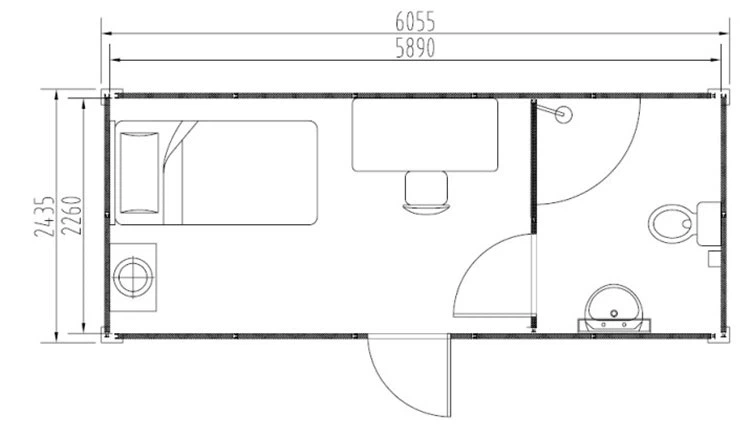
There is the different various house layout
The below one is just for your reference only. If you have the new project, welcome to show us, we can custom made as your request.

Container house types
Container houses are a versatile and innovative approach to sustainable and cost-effective housing solutions. Within this category, we can further classify them into three main types: Flatpack Container House, Detachable Container House, and Expandable Container House.
Flatpack Container House:
Flatpack container houses are a subcategory known for their convenient and efficient assembly. These homes are typically shipped in a flat, disassembled state and can be quickly put together on-site. Their key features include easy transport, rapid assembly without the need for extensive construction skills, and the ability to be customized to suit specific requirements.
Detachable container houses are designed with flexibility and reusability in mind. They can be easily taken apart and reassembled in different locations. Portability is a significant advantage, making them suitable for people who frequently relocate or for businesses in need of mobile workspaces. These houses are scalable, meaning they can adapt to changing needs by adding or removing modules.
Expandable container houses are known for their adaptability and space efficiency. They can be transported in a compact state and expanded on-site to create more livable space. These structures are suitable for various purposes, including housing, offices, and retail spaces. The expandable design allows for easy adjustments, making them versatile solutions for both temporary and permanent use.
Standard House plans
It is for the office, with 1 door, 2 windows for office, living room, warehouse etc


Installation Steps
The installation of container houses usually includes the following steps:
Preparation: Clean and level the installation area, ensure compliance with local codes and building standards, and obtain necessary permits and approvals.
Foundation work: Constructing a solid foundation, such as a concrete foundation or foundation piles, to ensure the stability of the home.
Place the container: Use a crane or crane to place the container on the foundation, keeping it level and stable.
Structural Reinforcement: Make necessary structural reinforcements, including supports and attachment points, to ensure the safety and stability of the home.
Interior and exterior finishing: Installation of insulation, interior partitions, windows, doors and exterior paint and trim.
Hookups: Install electrical, plumbing and drainage systems to ensure the house has the necessary utilities.
Detail Work: Complete interior and exterior detail work, including flooring installation, painting, lighting, and set-up of kitchen and bathroom fixtures.
Final inspection: Conduct final inspections and tests t ensure the home is operating properly and meets safety standards.

These steps may vary depending on the size and specific requirements of the project, but they represent the general process for container home installation. Installation should be done by experienced professionals or qualified contractors to ensure the quality and safety of the home.
FAQ
What are the uses of shipping containers?
Why choose shipping container as building material?
What are container houses, and why are they relevant today?
How do container houses contribute to sustainability?
What are the economic advantages of container houses?
How quickly can container houses be constructed, and in what scenarios is this speed beneficial?
How can container houses be customized to suit different preferences and needs?
What is a mobile expandable prefab house, and how does it differ from traditional housing?
What are the key advantages of using an expandable prefab house over conventional construction?
How are these houses constructed, and what materials are commonly used in their manufacturing?
What is the size and layout of these houses, and can they be customized to suit individual needs?
How mobile are these houses, and what transportation methods are typically used to move them?
Are these houses suitable for different climates and environmental conditions?
What infrastructure and utilities are required for these houses to function properly?
Can these houses be expanded or modified after initial setup?
Are there any legal or zoning considerations to be aware of when using mobile prefab houses?
What are the maintenance requirements for mobile expandable prefab houses?
What are the uses of shipping containers?
In addition to being used for maritime transportation, shipping containers can also be used in residential buildings, offices, commercial displays, storage, and even art installations. Due to its superior structure, durability, and ease of mobility, more and more people are using shipping containers to construct unique residences or business premises.
Why choose shipping container as building material?
Choosing shipping container as a building material has the following advantages:
- Can be installed quickly: the internal structure of the shipping container is ready-made, and the construction can be completed with only simple modifications and processing.
-Chaoyang is practical: shipping container can be very cost-effective, and it is also very environmentally friendly.
- Can be moved: due to the mobility of the shipping container, they can be easily moved to the desired location, very flexible.
- High construction strength: The shipping container is like a solid iron box, which can withstand long-term and continuous use and is extremely durable.
What are container houses, and why are they relevant today?
Container houses are dwellings constructed by repurposing shipping containers, originally designed for transporting cargo. They are relevant today for several reasons. First, they offer a sustainable housing solution by reusing materials, reducing waste, and giving a second life to shipping containers. Second, container houses are affordable, making homeownership more accessible for individuals and communities on a budget. Third, they can be rapidly constructed, addressing the need for quick housing solutions during emergencies or housing crises. Lastly, their modular design allows for easy customization and expansion, providing a versatile housing option for various needs.
How do container houses contribute to sustainability?
Container houses contribute to sustainability in multiple ways. First and foremost, they repurpose shipping containers that would otherwise become waste, reducing the environmental impact of discarded containers. This eco-friendly approach decreases the demand for new building materials, lowering the carbon footprint associated with construction. Additionally, container houses can be designed with energy-efficient features, such as insulation and solar panels, further enhancing their environmental benefits.
What are the economic advantages of container houses?
Container houses offer significant economic advantages. They are cost-effective to build and typically more affordable than traditional housing. The primary savings come from reusing shipping containers, reducing the cost of new building materials. Additionally, the speed of construction can lead to lower labor costs, and their modular nature allows for easy scalability, eliminating the need for large upfront investments. These factors make container houses an attractive option for those looking to own a home or invest in real estate with a limited budget.
How quickly can container houses be constructed, and in what scenarios is this speed beneficial?
Container houses can be assembled relatively quickly, typically much faster than traditional construction methods. The speed of construction is particularly beneficial in several scenarios. During emergency situations such as natural disasters or humanitarian crises, quick housing solutions are essential. Container houses can be rapidly deployed to provide shelter and support. Additionally, in areas with housing shortages, container houses can be a viable option to address the immediate need for housing units.
How can container houses be customized to suit different preferences and needs?
Container houses are highly customizable. Their modular design allows for easy customization, both in terms of the exterior and interior. They can be modified to include various layouts, sizes, and architectural styles. Interior finishes, such as flooring, wall treatments, and fixtures, can be tailored to meet specific preferences. This adaptability makes container houses suitable for a wide range of applications, including single-family homes, offices, cafes, or retail spaces. The possibilities for customization are virtually endless, making them a versatile housing solution.
What is a mobile expandable prefab house, and how does it differ from traditional housing?
A mobile expandable prefab house is a compact, modular structure that can be transported and assembled quickly. It differs from traditional housing in its mobility and prefabrication, making it suitable for various applications like temporary housing or remote locations.
What are the key advantages of using an expandable prefab house over conventional construction?
Expandable prefab houses offer cost savings, reduced construction time, flexibility in design, energy efficiency, and the ability to easily relocate them as needed.
How are these houses constructed, and what materials are commonly used in their manufacturing?
Expandable prefab houses are usually constructed using steel or aluminum frames and various prefabricated panels made of materials like steel, wood, or composite materials.
What is the size and layout of these houses, and can they be customized to suit individual needs?
The size and layout can vary, but expandable prefab houses often come in different modules that can be customized to create various room configurations, depending on the user's requirements.
How mobile are these houses, and what transportation methods are typically used to move them?
Expandable prefab houses are designed for mobility, and they can be transported by road, rail, sea, or even air if necessary. Their modular design makes them easy to disassemble and reassemble.
Are these houses suitable for different climates and environmental conditions?
Yes, expandable prefab houses can be designed with insulation and climate control systems to make them suitable for a wide range of climates, including extreme cold or hot environments.
What infrastructure and utilities are required for these houses to function properly?
Expandable prefab houses need access to electricity, water, and sewage connections or can operate with self-contained systems like solar panels, water tanks, and composting toilets.
Can these houses be expanded or modified after initial setup?
Some expandable prefab houses allow for future expansion or modification by adding more modules or altering the existing layout, providing flexibility as needs change.
Are there any legal or zoning considerations to be aware of when using mobile prefab houses?
Depending on the location, there may be zoning regulations and building codes that need to be considered. It's essential to research and adhere to local laws and permits.
What are the maintenance requirements for mobile expandable prefab houses?
Maintenance typically includes regular inspections, cleaning, and upkeep of utilities and systems. The exact maintenance needs may vary depending on the specific design and materials used in the house.
Hot Tags: Prefab shipping containers, China Prefab shipping containers manufacturers, suppliers, factory, multi purpose expandable house, prefab expandable house, Prefabricated Expandable Container House, expandable prefab homes, expandable container homes, fast installation container house
You Might Also Like


Send Inquiry
