
Five Basic Forms Of Steel Structures And Selection Guide For Beginners
In the realm of civil engineering and architectural design, steel structures stand out for their exceptional mechanical properties and adaptability. For beginners venturing into this field, grasping the five fundamental forms of steel structures and their selection criteria is pivotal. We delve into light steel structures, steel frame structures, steel grid structures, membrane structures, and steel tube structures, providing a professional analysis of their structural characteristics, application scenarios, and key design considerations.
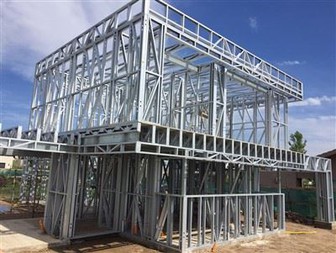
Light Steel Structure: The Optimal Choice for Small and Medium-Sized Industrial Buildings
Light steel structures, characterized by their portal frame systems (H-shaped steel columns and beams), purlin systems (CZ steel), and standardized support systems, excel in load efficiency and cost-effectiveness. Typically, they use light steel roof trusses (with a self-weight of 0.1-0.3kN/m²), reducing the foundation engineering volume by 40-60% compared to reinforced concrete structures.
Typical Application Scenarios
-
Industrial facilities: Single-story industrial plants (such as machinery factories and metal processing plants) with spans of ≤30m and eaves heights of ≤8m.
- Commercial spaces: Small and medium-sized enterprise workshops, logistics warehouses, etc., where the construction period can be shortened by 40% compared to traditional reinforced concrete structures, and the cost is 20-30% lower.
Key Design Considerations
-
Span Control: For spans exceeding 30m, adopt truss forms or add intermediate supports to avoid excessive internal forces.
- Load Adaptation: When the live load exceeds 20kN, prioritize rigid frame structures; for ultra-high eaves heights, use lateral bracing systems.
- Node Design: Hinged nodes should only be used for structures with no horizontal loads or light horizontal loads, as they have limited resistance to horizontal forces.
Steel Frame Structure: Spatial Flexibility for Multi-Storey and High-Rise Buildings
Steel frame structures, composed of H-shaped steel beams and columns connected by rigid or semi-rigid nodes, offer unparalleled spatial division flexibility. The beam-column joints can be designed as rigid (fully welded) or semi-rigid (bolt-connected), allowing column spacing to reach up to 8m, which is ideal for open-plan layouts.
Structural Advantages
- Multi-Storey Applications: Suited for 4-15 storey buildings (such as SOHO complexes), enabling free planar division and meeting the needs of open-plan apartments.
- Industrial Buildings: Applicable to heavy-duty industrial plants, capable of bearing loads above 50kN.
- Seismic Performance: In high-seismic-intensity areas (like Sichuan, Japan), steel frames combined with energy-dissipating components demonstrate excellent seismic performance.
Core Design Points
- Height-to-Weight Ratio: For ratios exceeding 1:5, set core tube structures or support systems, and control the inter-story drift angle within 1/250.
- Node Optimization: Use "weak node, strong component" design principles to enhance the structure's energy-dissipating capacity through node deformation.
- Floor Slabs: Composite steel-concrete slabs (with a thickness of 80-120mm) can reduce structural layers and improve space utilization.


Steel Grid Structure: Force-Resisting Pioneer for Large-Span Spaces
Steel grid structures, formed by intersecting chord members (solid or hollow sections) and web members (angle steel or steel tubes) at nodes, achieve uniform force distribution and efficient load transmission. The grid's thickness is typically 1/10-1/15 of the span, and the self-weight ranges from 30-50kg/m², making it ideal for large-span roofs.
Standard Application Fields
- Cultural and Sports Venues: Roofs of stadiums (with spans exceeding 80m) and large auditoriums, enabling column-free spaces.
- Transportation Hubs: Terminal buildings of airports and railway stations, ensuring unobstructed traffic flow.
- Industrial Plants: Ultra-large-span workshops (over 300m) and logistics centers, compatible with automated vehicle systems.
Technical Selection Essentials
- Planar Layout: Prioritize orthotropic or bidirectional orthogonal grid layouts; for irregular plans, use three-directional grids.
- Node Treatment: For spans exceeding 60m, adopt ball joints (factory prefabrication and on-site assembly) to reduce on-site welding workload.
- Wind Load Considerations: For membrane-covered or glass-covered grids, strictly calculate wind suction (local negative pressure can reach 1.5kPa) to prevent component damage.
Membrane Structure: Aesthetic and Functional Integration for Architectural Innovation
Membrane structures, consisting of membrane materials (PTFE, ETFE, PVC, etc.), tensioning systems (cables/rods), and support structures, offer lightweight, transparent, and creative design possibilities. With a self-weight of only 0.1-2.5kg/m² and tensile strengths reaching 50-150MPa, they are widely used in large-span, open spaces.
Innovative Application Areas
- Recreational Facilities: Large-scale water parks (with human-membrane interaction) and commercial plaza canopies.
- Ecological Buildings: Greenhouses (with environmental protection and energy-saving features), where ETFE membranes achieve a light transmittance of over 85%.
- Temporary Structures: Large-scale exhibition halls (including national pavilions), with a service life of 15-30 years and reusable components.
Material and Design Focus
- Material Selection: PTFE membranes (self-cleaning, flame-retardant) are suitable for permanent buildings; PE membranes (cost-effective) are ideal for temporary structures.
- Load Calculation: In typhoon-prone areas (with wind pressures up to 1.2kPa) or heavy snow regions (1.0kPa snow load), conduct strict load verification.
- Shape Optimization: Use 3D modeling for shape-finding analysis, controlling the membrane's water-holding rate below 4%, and design drainage systems to avoid "water accumulation" issues.
Steel Tube Structure: The Perfect Blend of Industrial Strength and Architectural Elegance
Steel tube structures, constructed from round or square steel tubes connected by welded or bolted nodes, offer high strength, corrosion resistance, and architectural aesthetics. With a service life of up to 50 years (with anti-corrosion treatment), they are widely used in industrial and civil engineering.
Versatile Application Scenarios
- Industrial Plants: Heavy-duty factories (with spans of 40-60m) capable of bearing loads above 50kN.
- Bridge Engineering: Long-span bridges (such as cable-stayed bridges) with spans up to 150m, reducing concrete usage by 60%.
- Landmark Buildings: Large-scale stadiums (like the Bird's Nest) and art galleries, where curved steel tubes create unique architectural forms.
Structural Design Details
- Section Selection: Use circular sections (≤30m spans), triangular sections (medium-span), and rectangular sections (long-span) based on span sizes.
- Member Layout: Control the slenderness ratio between 1:5-1:3, and use high-strength steel (such as Ax150 for tension members and Ax500 for compression members).
- Node Construction: Use arc welding or friction stir welding for node connections, and ensure the angle between supports and main members is ≥30° to guarantee connection quality.